

Germany and Austria both permit prostitution within a legal framework, but they organise that framework in different ways. For visitors, the difference is less about whether sex work is legal and more about registration, health administration, venue licensing and the visible rules surrounding a club.
Both countries also distinguish lawful, regulated businesses from exploitation, trafficking and unlicensed activity. The practical experience can vary between cities and venues, so the details below describe the main national pattern rather than every local exception.

The shared legal basis
In Germany and Austria, consenting adults may provide sexual services legally. Sex workers can operate independently or work through licensed businesses, while clients are allowed to pay for services within the applicable rules. The law does not turn every brothel, club or private arrangement into a lawful operation automatically.
The central dividing line is regulation. Businesses need to meet local requirements, operators must comply with employment, tax, safety and public-order rules, and authorities can act against coercion, trafficking or concealed commercial activity. Austria’s general position is explained in this overview of why prostitution is legal in Austria.
Germany’s registration system
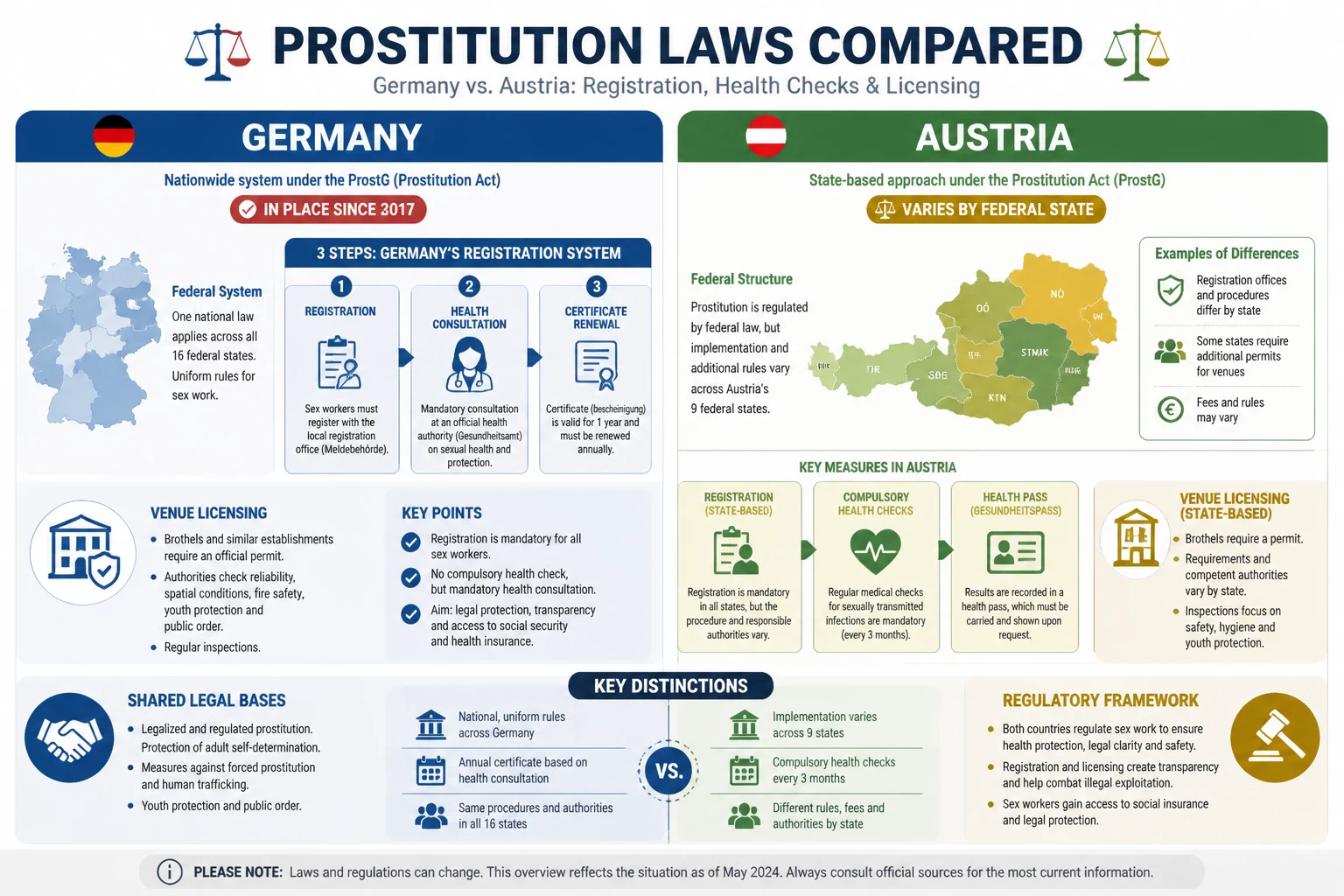
Germany’s Prostitutes Protection Act, introduced in 2017, created a nationwide registration system for people who work as sex workers. A person generally has to register with the competent authority before starting, attend a health information consultation and renew the registration at set intervals. The registration certificate is personal, and the process is intended to connect sex workers with official advice and basic legal information.
The system is not the same as a general licence for a particular venue, nor does registration make every working arrangement lawful. It places formal duties on the individual sex worker and separate duties on the operator. Germany’s reforms and their effect on the industry are discussed in this account of the new prostitution laws in Germany, with later developments covered in the report on the aftermath of the new prostitution laws.
Austria’s state-based approach
Austria does not have one single prostitution code that works identically from Lake Constance to Vienna. The Länder set important rules covering where sex work may take place, which businesses may operate and what local administrative conditions apply. Vienna therefore has its own system, while other federal states can impose different location or operating rules.
Austria generally does not use Germany’s nationwide sex-worker registration model. Instead, official identification, local rules and health administration play a larger role. The question of registration is more nuanced than a simple national yes or no, as outlined in this guide to whether sex workers need to register in Austria.
Health checks and certificates
Austrian sex workers are subject to compulsory health controls under the country’s public-health framework. In practical terms, this means regular medical examinations and official confirmation that the required checks have been completed. The system is commonly associated with the colloquial phrase “health pass”, although the paperwork and procedure depend on the responsible authority.
These checks are a public-health measure, not a guarantee that every infection has been excluded, and they do not replace safer-sex practices. The frequency, documentation and local process can differ by jurisdiction. A clearer explanation of the Austrian system appears in the guide to health checks required for sex workers in Austria.
Licensing the venues
Venue licensing is a separate issue from the legal status of sex work. A club, brothel, Laufhaus or similar establishment may need permission under local commercial, planning, building, safety and public-order rules. The operator remains responsible for the premises, records and conduct of the business, while the women working there may have their own independent arrangements.
In Austria, the permitted form of a venue can depend strongly on the federal state and municipality. Vienna has a well-established licensed club sector, ranging from discreet premises to larger houses with reception areas, bars and private rooms. A high-class licensed Vienna club such as Maxim Wien illustrates the kind of organised commercial setting visitors may encounter, though individual rules and services differ from house to house.
What travellers notice
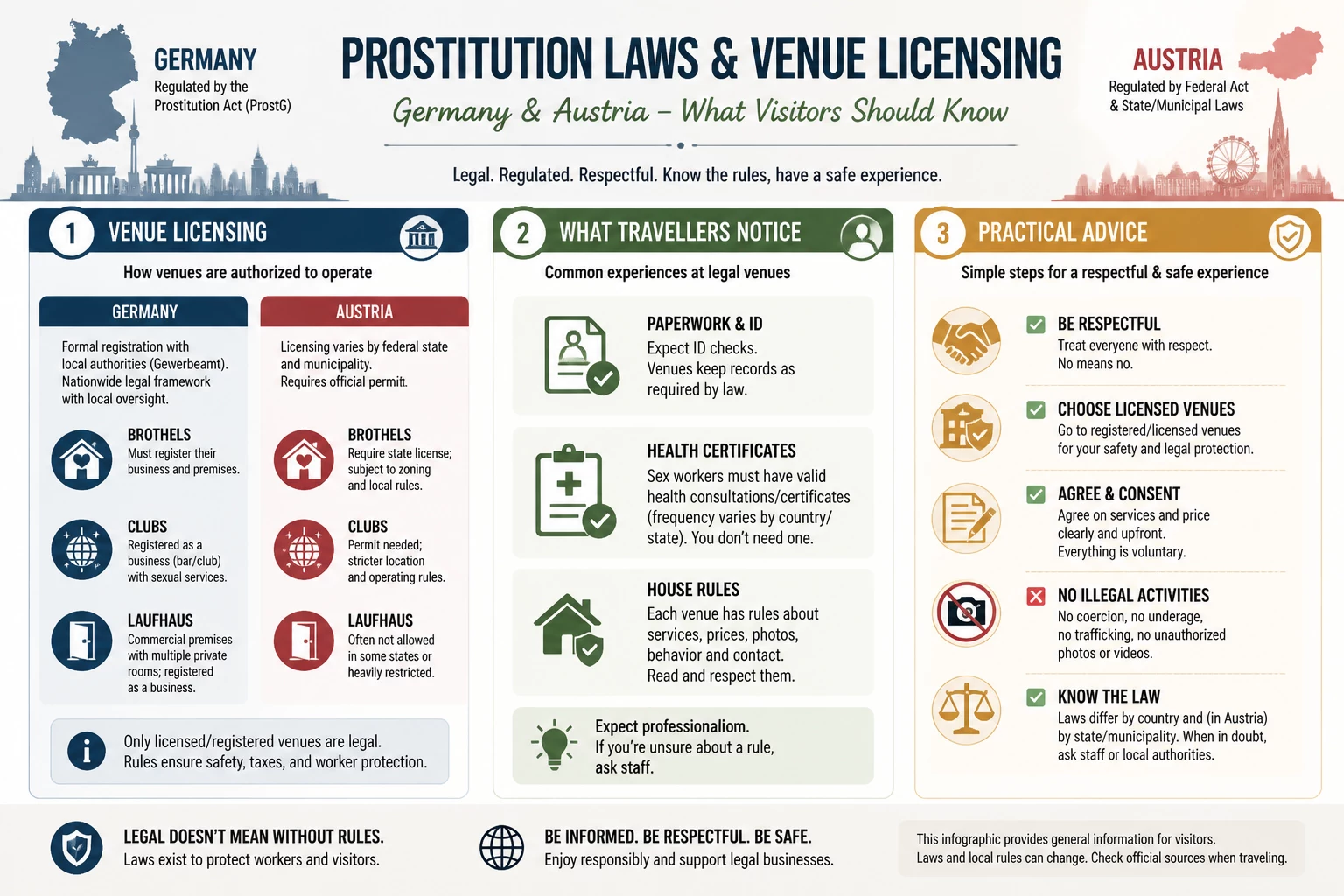
A traveller in Germany is more likely to encounter references to registration, official certificates and the responsibilities introduced by the Prostitutes Protection Act. Operators may have formal obligations concerning the premises and the people working there, and some cities apply additional local controls. The paperwork can therefore feel more visible and standardised, even though enforcement and presentation vary.
In Vienna and elsewhere in Austria, the visitor may notice the licensed venue first, along with evidence of health administration and local operating rules rather than a nationwide registration conversation. At a reputable club, the practical routine is usually straightforward: admission, house rules, clear payment arrangements and private discussions between the guest and the sex worker. Respecting boundaries and following staff instructions matters in both countries.
Lawful does not mean unregulated
Legal prostitution still operates within limits. Coercion, trafficking, violence and the involvement of people who cannot legally work are criminal matters, not grey areas created by the existence of licensed venues. A club’s polished appearance is not, by itself, proof of compliance, which is why licensing and responsible management matter.
Guests should use established venues, treat the women and staff respectfully, agree the terms before anything begins and avoid pressure, filming or unauthorised photography. Good clubs make boundaries and payment arrangements clear, provide a controlled environment and have procedures for dealing with problems. This practical look at how sex clubs protect both guests and sex workers explains why those systems are part of a legitimate operation.
The practical takeaway
Germany uses a national registration framework for sex workers alongside venue regulation. Austria relies more heavily on Länder laws, local licensing and compulsory health controls, without the same nationwide registration model. For a traveller, the difference appears in the paperwork and the way a venue presents its rules, not in a simple legal versus illegal split.
Choose a licensed establishment, follow its house rules and keep the arrangement clear and consensual. That approach fits the legal framework in both countries and makes for a more respectful, predictable visit.