
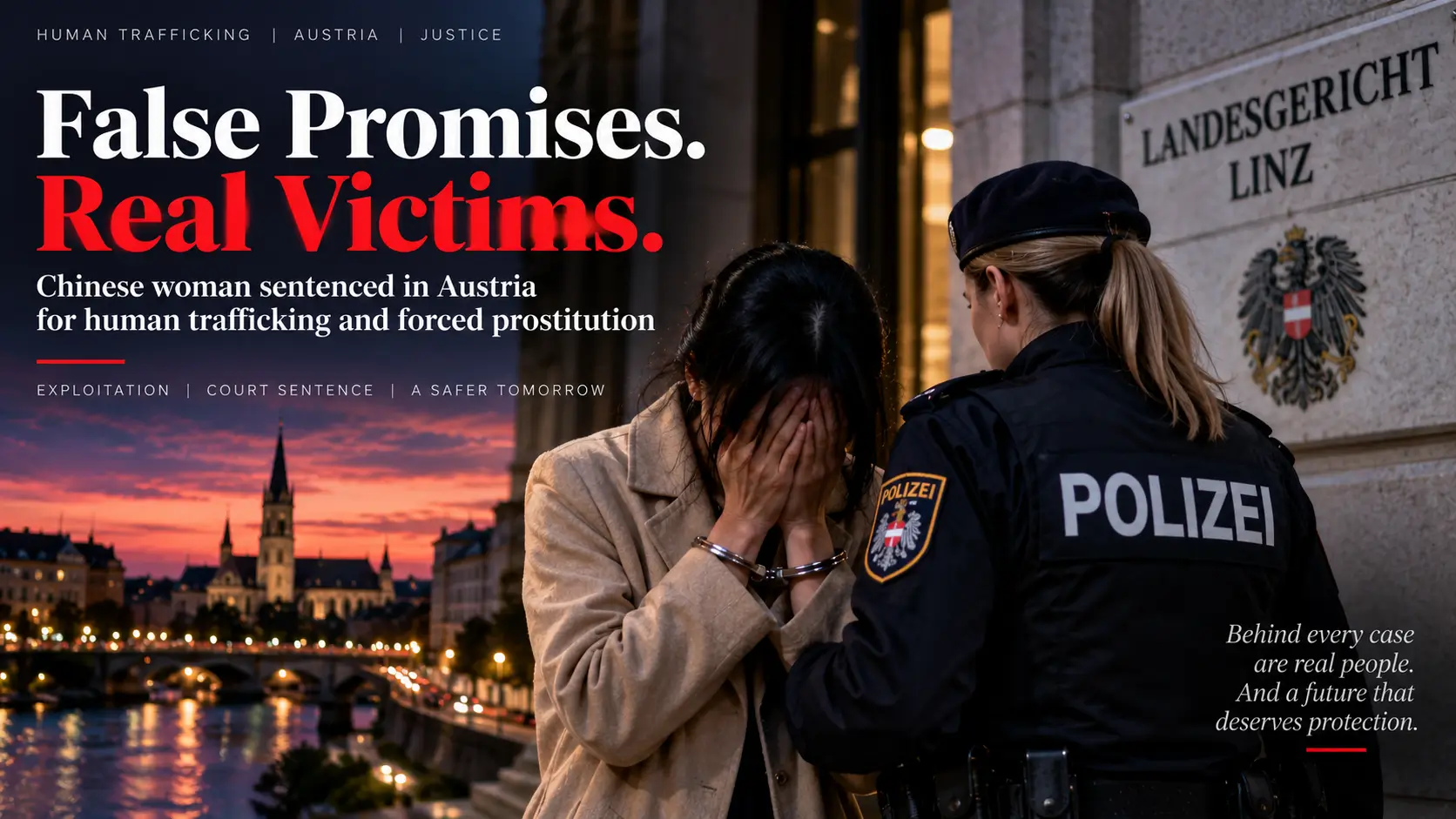
A 57-year-old Chinese woman has been sentenced to two years in prison in Austria after being convicted in a case involving human trafficking, forced prostitution and money laundering.
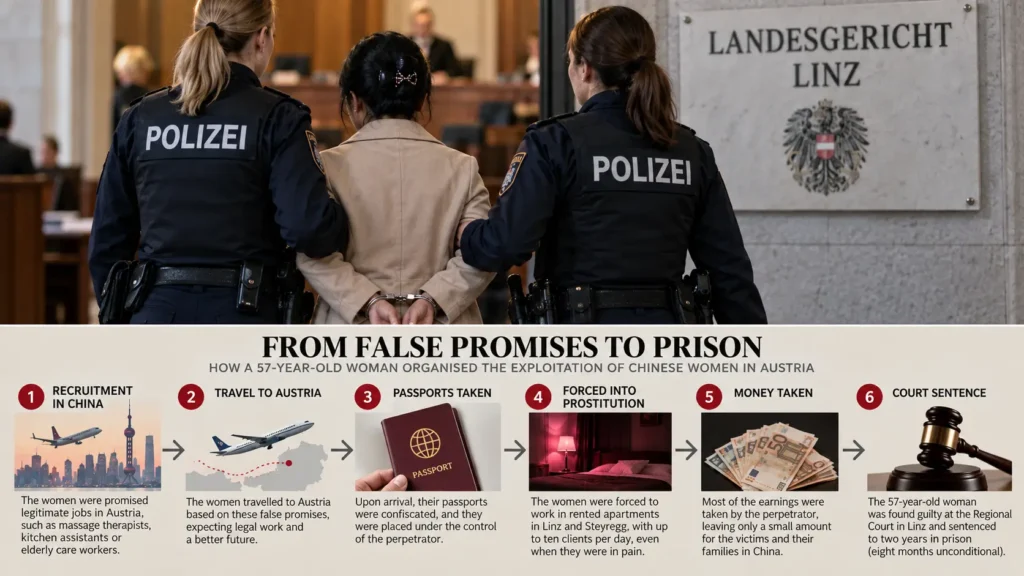
The case was heard at the Regional Court in Linz and involved several Chinese women who had been brought to Austria after being promised legitimate employment. According to the prosecution, the women believed they would find jobs as massage therapists, kitchen assistants or elderly care workers.
Instead, their passports were taken away and they were forced into prostitution.

Women reportedly had to see up to ten clients a day
The conditions described during the trial were severe. At least three women were allegedly forced to provide sexual services in apartments rented by the defendant in Linz and nearby Steyregg.
Prosecutors said some of the victims had to see as many as ten clients per day and were expected to continue working even when they were in pain. Much of the money they earned was taken from them, leaving only a small amount that could be sent to their families in China.
The 57-year-old was accused of acting on behalf of a larger criminal organisation. Authorities linked her to at least four properties allegedly used for illegal prostitution and said she was involved in arranging clients for the women.
Defence describes woman as a minor player
The defendant declined to testify about the accusations during the trial. Her lawyer argued that she was herself caught within a mafia-like structure and was “more victim than perpetrator.” The defence suggested that revealing the identities of those higher up in the organisation could put her in serious danger.
The court nevertheless found her guilty and imposed a 24-month prison sentence, eight months of which are unconditional. The judge acknowledged that the woman appeared to occupy a relatively low position in the organisation, stating that the masterminds were based in China.
Because the defendant had already been held in pre-trial detention since February and her request for early release was granted, she was able to leave prison shortly after the verdict.
A clear line between sex work and exploitation
The Linz case also highlights an important distinction in discussions surrounding Austria’s sex industry.
Consensual sex work between adults is fundamentally different from trafficking. When people are deceived about the work awaiting them, deprived of their passports, controlled financially and forced to provide sexual services, there is no meaningful consent.
For the legal sex industry, cases like this are particularly damaging because they risk blurring the distinction between independent sex workers and victims controlled by criminal organisations.
Effective enforcement against trafficking therefore protects not only its victims, but also the legitimacy and safety of those who voluntarily work within Austria’s regulated adult industry.
Why Working Legally Matters
Cases like this also show why there is an important difference between legal, voluntary sex work and prostitution controlled by criminal networks.
For sex workers who choose the profession, working legally and within Austria’s regulated system can offer significantly greater protection. A legitimate working environment makes it easier to maintain control over working conditions, earnings and the choice of clients, while also providing clearer access to healthcare, authorities and legal assistance when something goes wrong.
Legal establishments also operate in a more visible environment. That visibility makes it harder for practices such as passport confiscation, coercion, financial exploitation and trafficking to remain hidden. For clients, choosing legal and reputable establishments matters as well. It reduces the risk of unknowingly supporting businesses that profit from exploitation or human trafficking.
The Linz case is therefore not an argument against sex work itself. It is a reminder of why consent, legality and transparency matter. Adults who freely choose sex work should be able to do so under safer and fairer conditions — while those who exploit or traffic people should face serious consequences.