

Getting tested after a visit is the least dramatic part of the whole subject, and the part people postpone the longest. In Vienna the practical side is straightforward: the services exist, English is available, and the process takes less time than the evening that prompted it. What trips most people up is the timing, because a test taken on the wrong day answers a question you did not ask.

Why the date matters more than the test
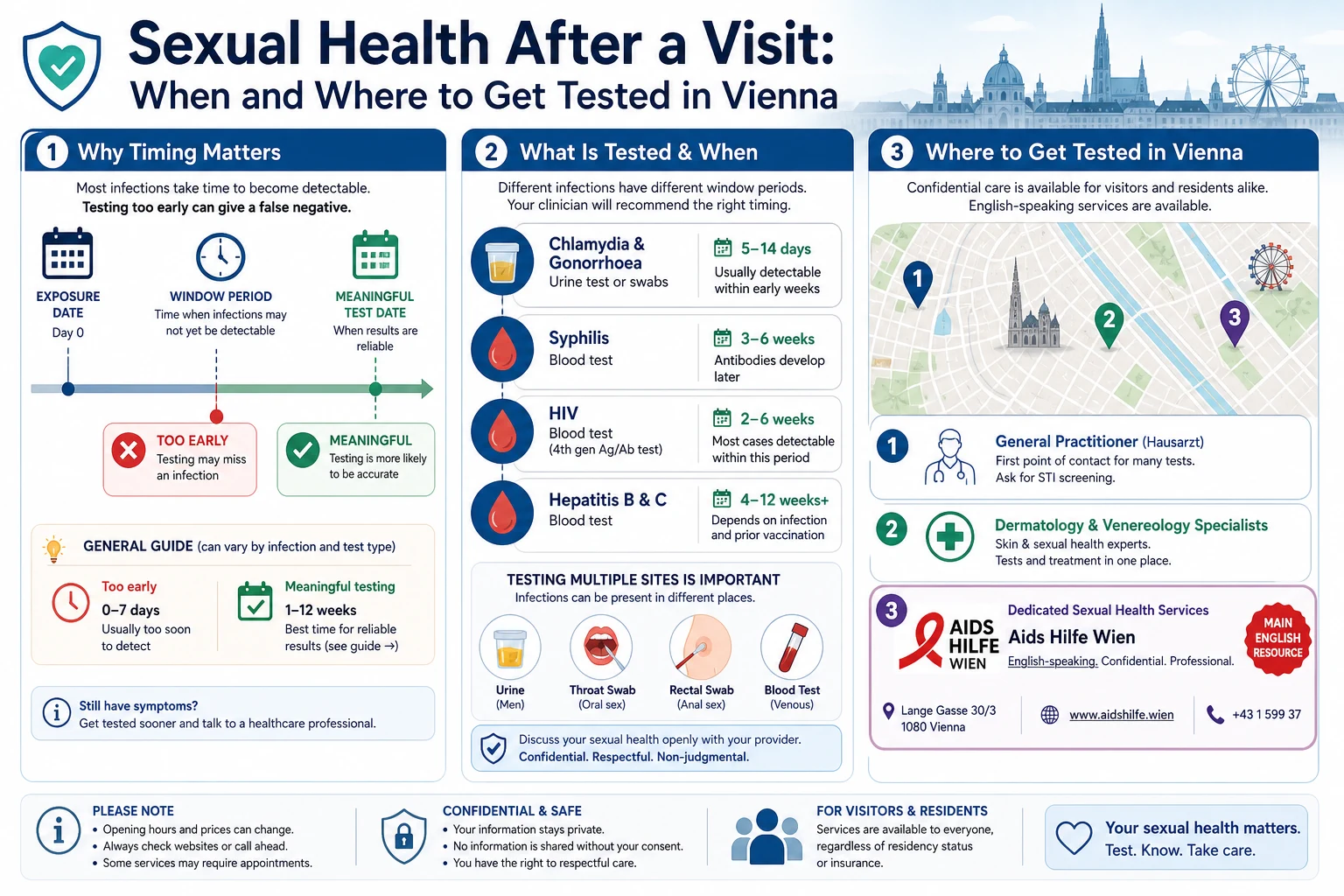
Every infection has a window period: the time between exposure and the point where a test can detect it. Test before that window closes and the result is not reassuring, it is simply too early.
This is why the morning-after test is the most common mistake in the whole area. It tells you about your situation before last night, which may be useful, but it says nothing about the visit that worried you.
The practical consequence is that you need two dates: the day of the exposure, and the day the test becomes meaningful. Clinics work with exactly this logic, which is why the first question you get asked is when it happened.
What is usually tested, and in what order
For a standard check after a sex club visit, the list is short and the sequence follows the window periods.
- Chlamydia and gonorrhoea, from a urine sample or swabs, typically in the first weeks after exposure.
- Syphilis, from a blood test, later than the bacterial panel.
- HIV, from a blood test, with the timing depending on the generation of test used.
- Hepatitis B and C, depending on your vaccination status and risk profile.
Swabs from the throat and the rectum are added when relevant, because infections at those sites are common and are missed by urine testing alone. Asking for the right sites is not awkward; it is the difference between a complete and an incomplete result.
Vaccination is worth a separate question. Hepatitis B vaccination is routine, and HPV vaccination is available for adults as well, not only for teenagers.
Where to go in Vienna
There are three normal routes: your general practitioner, a specialist in dermatology and venereology, and the dedicated services for sexual health.
For English-language information, testing options and current conditions, Aids Hilfe Wien is the practical first address, and it is also where questions about anonymity and cost are answered accurately rather than from hearsay.
Do not rely on a summary you read in a forum, including this one, for prices and opening hours. Those change, and the organisations publish the current version themselves.
If you are a visitor rather than a resident, you can still use these services. The legal position of tourists in the Vienna scene is covered in our article on whether tourists can legally visit sex clubs here, and the same principle applies to healthcare: being a guest in the city does not exclude you.
Anonymity, discretion and who learns what
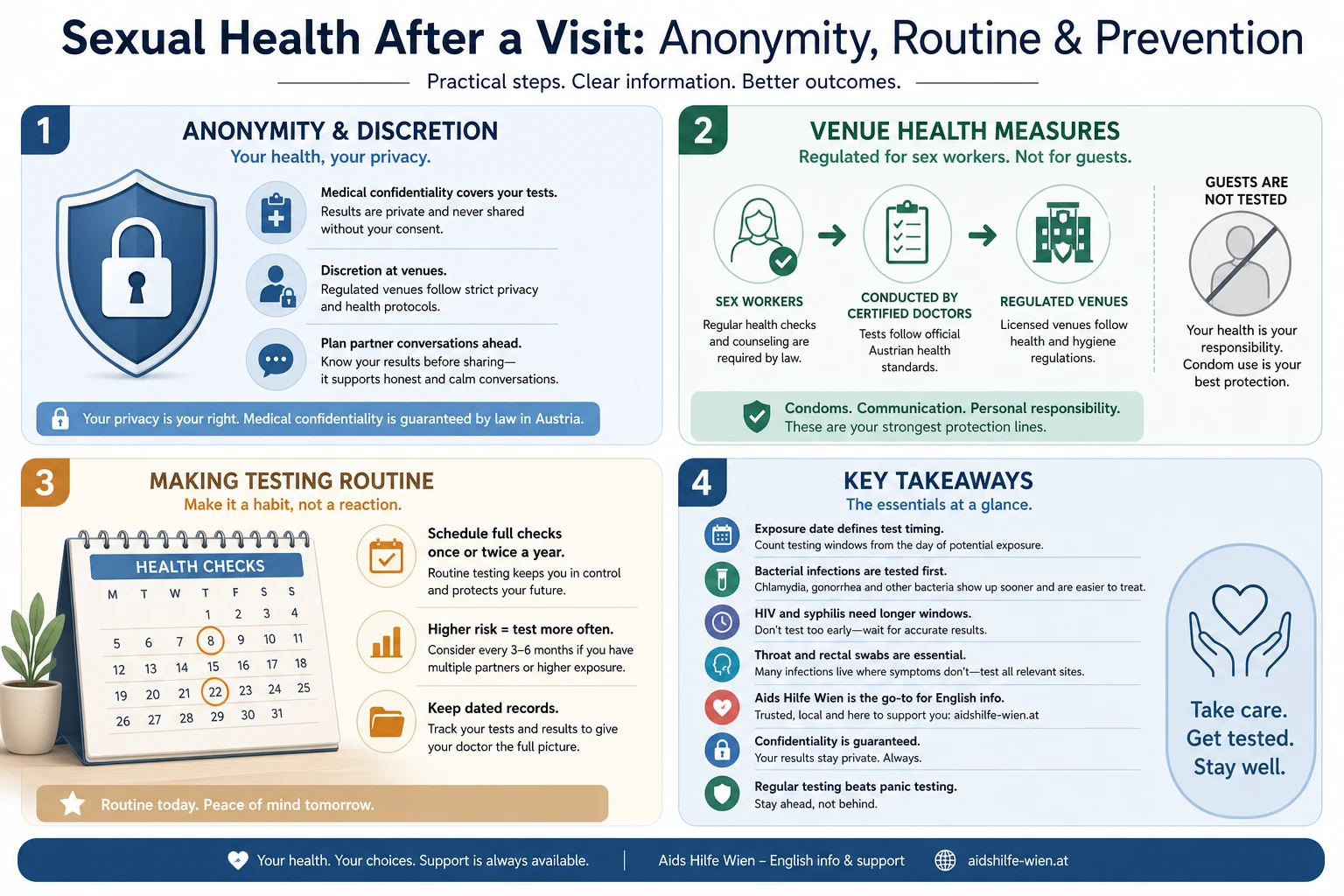
The most common reason for postponing a test is the fear that someone will find out. In practice, medical confidentiality covers these visits like any other, and the dedicated services are organised around discretion.
This is also true inside the venues. Vienna clubs treat privacy as part of the product, which is part of why regulars behave the way they do, a pattern described in why married men visit sex clubs.
The one thing worth planning is the partner conversation, if you have a partner. Deciding in advance what you will say is easier than improvising it while holding a result.
What the venue side already does
Sex workers in Austria are part of a regulated health system, with mandatory checks, and that regime is one of the reasons the Austrian scene works differently from an unregulated one. We covered the details in the health checks required for sex workers.
What that system does not do is test the guests. The clients are the unmonitored half of the equation, which is precisely why the personal routine matters.
Condom use remains the main line of defence, and the reasons for that are unchanged, as the list of venues that refuse unprotected services shows.
Turning it into a routine
People who visit regularly tend to move from crisis testing to scheduled testing, and it makes the whole subject much less dramatic.
A common pattern is a full check once or twice a year for occasional visitors, and more frequently for people with several partners or frequent visits. The right interval is a question for the clinic, not for a magazine.
Keep your results. A dated record makes every future conversation, medical or personal, shorter and clearer.
And treat the appointment as maintenance, not as a verdict. It belongs in the same mental category as the dentist, which is roughly how the guests who handle this best describe it, including those who wrote in about what surprised them at their first visit.
The short version
- The date of exposure decides when the test is meaningful; too early means nothing.
- Bacterial infections first, HIV and syphilis on a longer clock.
- Ask for throat and rectal swabs when relevant; urine alone can miss infections.
- Aids Hilfe Wien is the practical English-language address for testing questions.
- Confidentiality is standard; discretion is not a favour you have to negotiate.
- Regular, scheduled testing beats panic testing after every incident.