
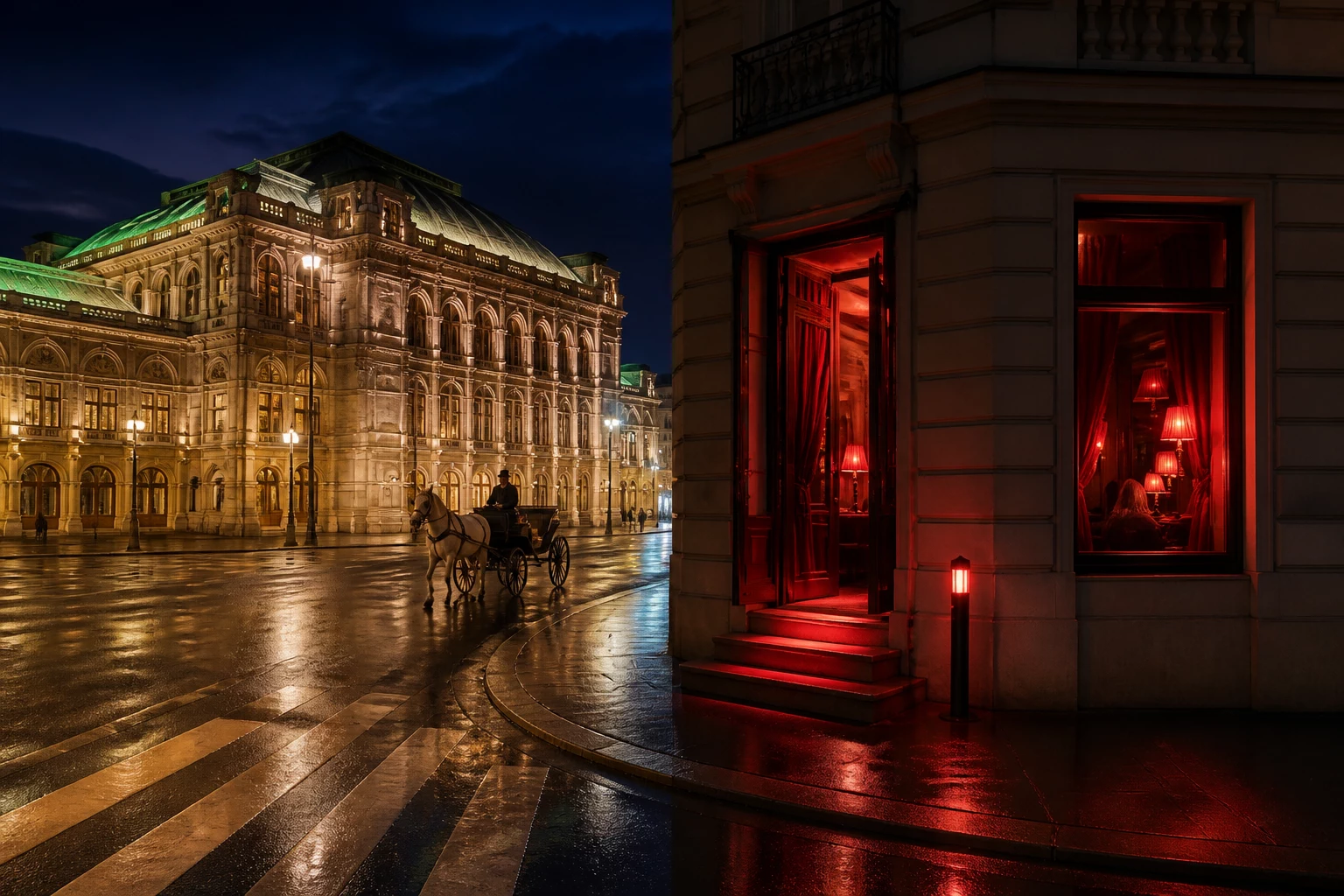
Vienna’s sex industry is legal, but it is not free to operate anywhere. Licensed brothels, clubs and other commercial venues are shaped by planning rules, neighbourhood protections and the city’s approach to public order.
That is why some parts of Vienna have a visible concentration of licensed venues, while other districts remain largely residential and quiet. The dividing line is not simply a map of nightlife. It reflects permissions, building use, street activity and the presence of sensitive institutions.

The basic legal framework
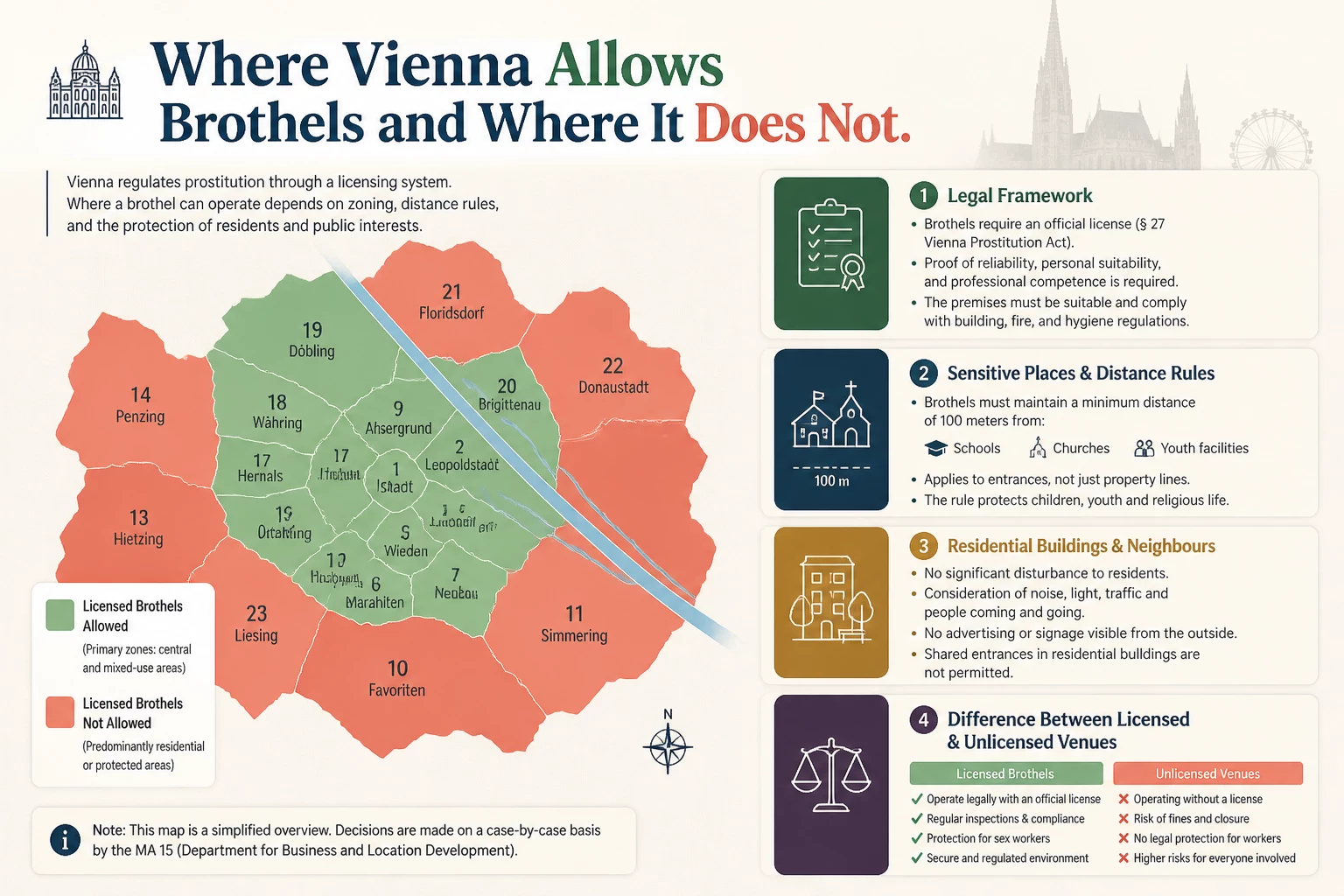
In Vienna, prostitution is regulated rather than prohibited outright. A venue needs to operate within the relevant licensing and commercial framework, and the premises must be suitable for the activity taking place there. That involves more than putting a sign above a door. Building use, fire safety, hygiene, employment arrangements and local administrative requirements all matter.
The rules distinguish between a properly authorised establishment and an unlicensed flat, studio or improvised commercial space. A licensed venue is expected to provide a controlled setting in which sex workers can work legally and visitors know that the business is accountable. The difference is explored in more detail in this guide to licensed brothels and illegal sex studios.
Sensitive places and distance rules
One of the central principles is protection for places used by children, families and local communities. Schools, kindergartens, churches, youth facilities and similar institutions can affect whether a sexual entertainment business is permitted nearby. The relevant authority considers the relationship between the proposed venue and these sensitive locations, including access routes and the character of the surrounding area.
There is no useful citywide rule of thumb that visitors can apply from a map. Distance requirements and planning decisions depend on the type of venue, the exact premises and the applicable administrative decision. A location that appears suitable from the street may still be refused because of its proximity to a protected use, or because the building’s approved purpose does not support the proposed business.
Residential buildings and neighbours
Residential surroundings are another important consideration. Vienna does not treat every building containing flats as automatically off limits, but a venue must fit its setting. Noise, late-night arrivals, signage, security, shared entrances and the effect on residents can all influence how an application is assessed and how an existing business is expected to operate.
This explains why a discreet commercial property, a former hospitality site or a building in a mixed-use district may be more practical than a quiet apartment block. A business that creates repeated disturbance can attract complaints and administrative attention even when sexual services themselves are legal. For visitors, the sensible habit is simple: enter and leave quietly, respect shared spaces and follow the venue’s house rules. The broader etiquette is covered in this guide to behaviour in Vienna’s brothels.
Why venues cluster
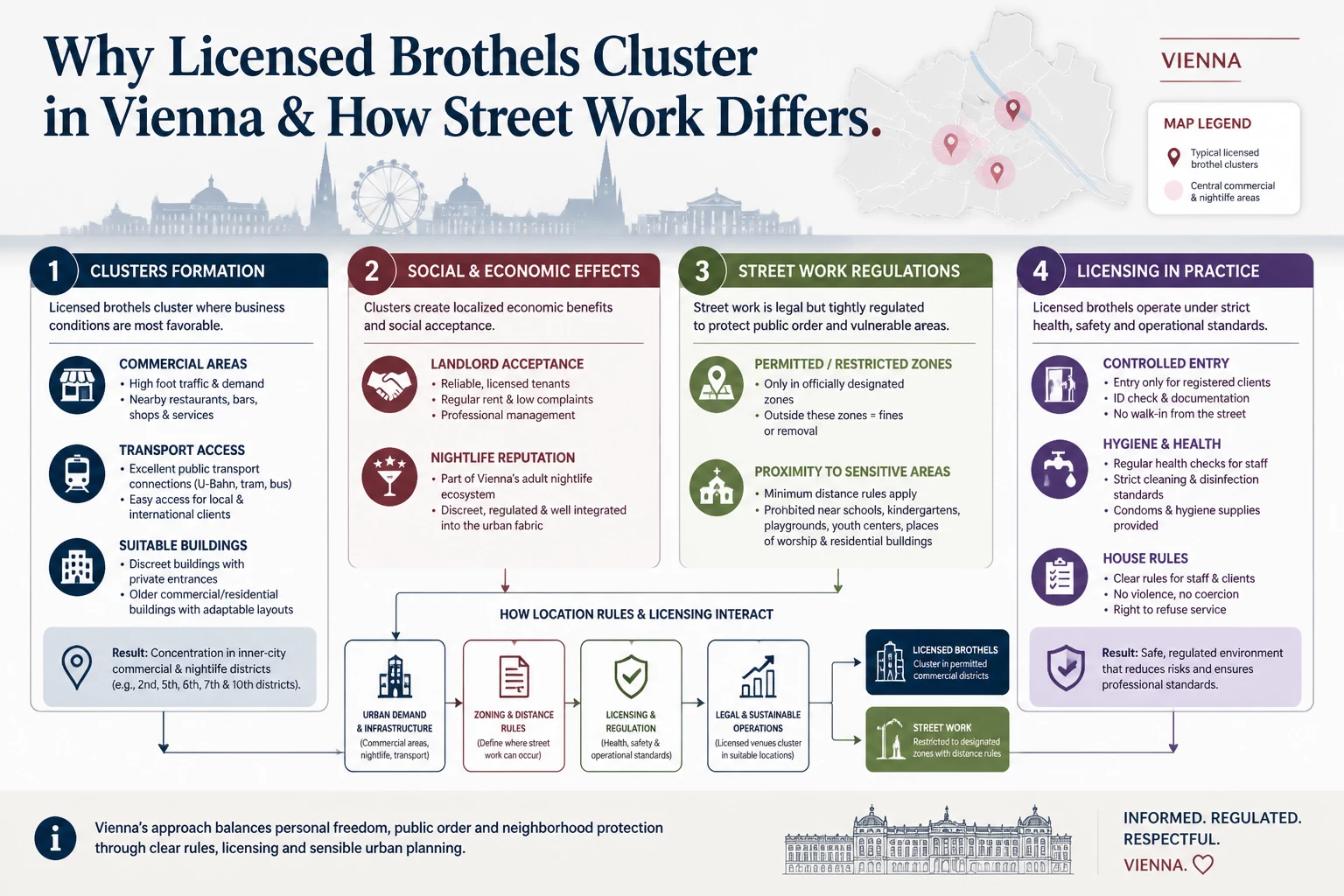
Clusters form when several practical advantages meet. Commercial areas with existing nightlife, good public transport and suitable larger premises are more likely to accommodate licensed venues than purely residential streets. Properties with reception areas, lounges, private rooms, ventilation and adequate sanitation are easier to adapt when the building’s use permits it.
There is also a social and economic effect. Once an area is known for nightlife, landlords, customers and businesses understand its character, and new operators may find the setting less surprising for neighbours than an isolated venue elsewhere. This does not mean every establishment is identical. Some are modest and functional, while others invest heavily in atmosphere, design and hospitality, as this look at why some Vienna brothels feel more luxurious explains.
Street work is different
Street-based prostitution is governed differently from work carried out inside a licensed venue. Public visibility, traffic, residents and the use of pavements or roads make location especially sensitive. Vienna can define areas in which street work is permitted and areas in which it is restricted or prohibited, with rules designed to separate it from schools, residential concentrations and other places where conflict is likely.
These arrangements can change through local decisions and enforcement practice. A street that appears quiet during the day may have a very different character at night, and a district’s residents may object to activity near homes even when the workers themselves are operating legally. Reporting about street prostitution in a residential area of Liesing illustrates why the location of public activity remains a recurring issue.
What licensing means in practice
Licensing is not a blanket endorsement of everything that might happen inside a venue. It means that the business has entered a regulated framework and must meet the conditions attached to its operation. The premises, management and working arrangements remain subject to legal duties, and serious breaches can bring inspections, penalties or closure.
For a visitor, the signs of a more established operation are usually practical rather than theatrical: clear house rules, controlled entry, a professional reception area, visible attention to hygiene and a straightforward approach to payment. Wellness facilities may also form part of the offer, but they still need to be maintained properly. The guide to sauna, whirlpool and wellness hygiene sets out why these details matter.
Reading the city sensibly
Vienna’s official information is the best starting point for the current legal position, especially because municipal rules and administrative interpretations can develop over time. The City of Vienna’s information on prostitution explains the public framework without treating every venue or district as interchangeable.
For visitors comparing different types of licensed establishment, a discreet, hospitality-led club such as Maxim Wien shows how the legal market can range from straightforward premises to more polished settings. Details vary by house and should be checked before travelling.
A practical way to think about it
Licensed venues are generally found where commercial use, transport, building design and local planning conditions come together. Schools, churches, youth facilities, residential sensitivities and public-space rules can all limit what is possible.
So the useful question is not simply where nightlife exists, but whether a particular address has the right permission and setting. Choose established premises, respect the neighbourhood and remember that legal operation depends on the venue following its conditions, not merely on the district’s reputation.