

Money is the part of a sex club visit that most first-timers dread, and not because it is expensive. The fear is sounding cheap, pushy or clumsy in a conversation that lasts thirty seconds. The good news is that this conversation is completely routine for everyone who works in the venue, and there is a simple way to have it.

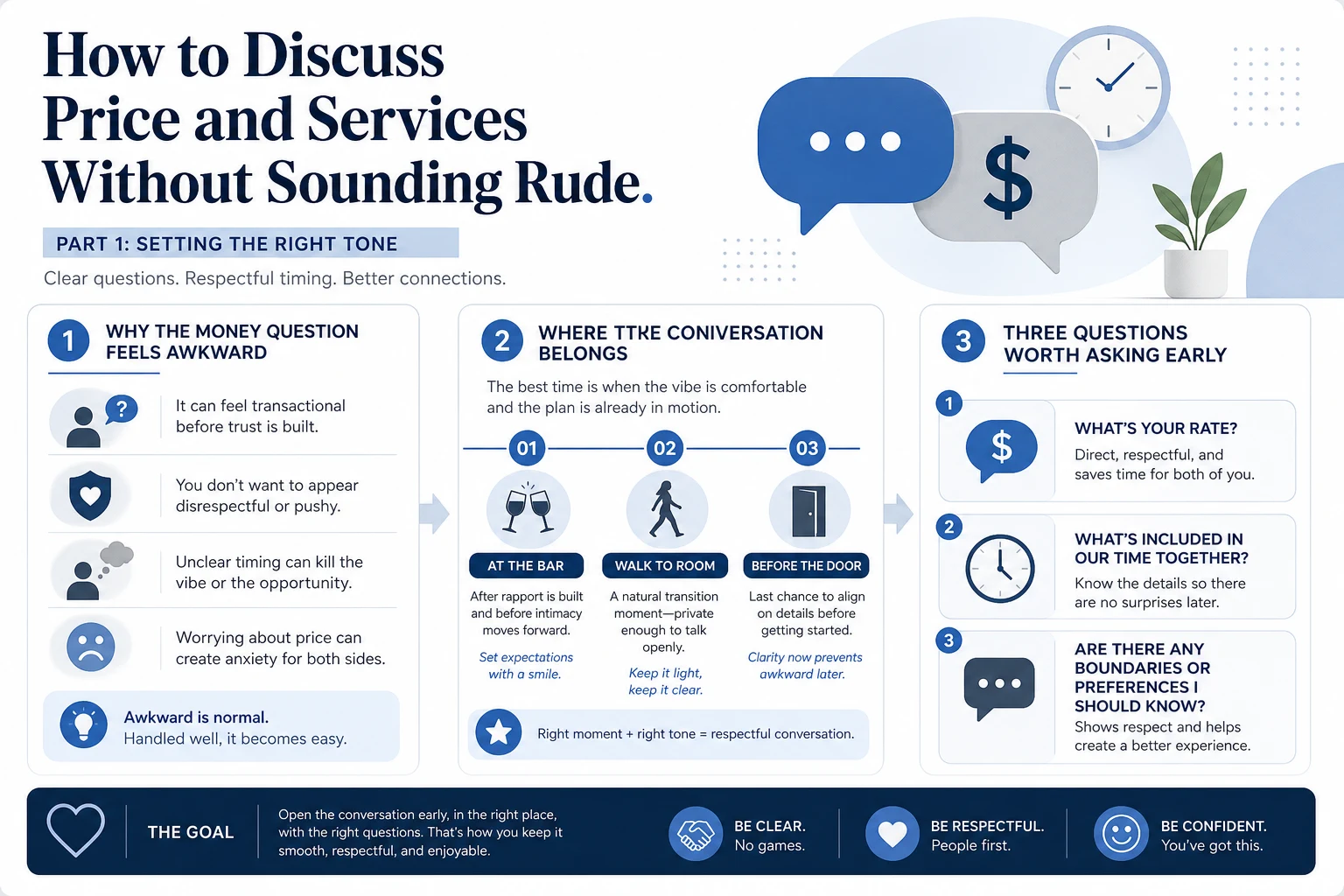
Why the money question feels awkward
In most of daily life, price is printed somewhere. In a sex club the entry fee and the drinks are printed, but the service itself is agreed between you and the sex worker, because she is self-employed and sets her own rates and her own limits.
That gap is what creates the discomfort. You are used to reading a number; here you have to ask a person. Many guests then avoid the topic entirely, hope it resolves itself, and end up in a room where neither side knows what was agreed.
The irony is that skipping the question is the rude version. Asking clearly, early and calmly is the respectful one, because it saves both of you from a misunderstanding halfway through.
Where the conversation belongs
There are three moments in a visit: the bar, the walk to the room, and the room itself. The money conversation belongs to the first two.
At the bar you are still in a social setting. How much time you have for that depends on the night: the room to talk is very different on a quiet Tuesday than on a full Saturday, as our piece on busy and quiet nights describes. A short, direct question there is normal and expected. Once the door closes, the negotiation is over and the time you paid for has started, so bringing up price at that point feels like a renegotiation.
If you are unsure whether the moment is right, look at how the conversation is going. If she has sat down with you and the small talk has started, you are in the right window. There is more on how that first stretch of the evening works in our guide on what first-time visitors misunderstand about sex clubs.
Three questions worth asking early
Keep it short. Three questions cover almost everything, and none of them sounds like haggling.
- How long is the standard time, and what does it cost?
- What is included in that, and what is extra?
- Is there anything you do not offer?
The third one matters more than people expect. Every sex worker sets her own service list, and the fastest way to be polite is to ask once instead of discovering a boundary in the room. Our article on roleplay and fantasy chambers shows how varied the offers can be from one person to the next.
Wording that works
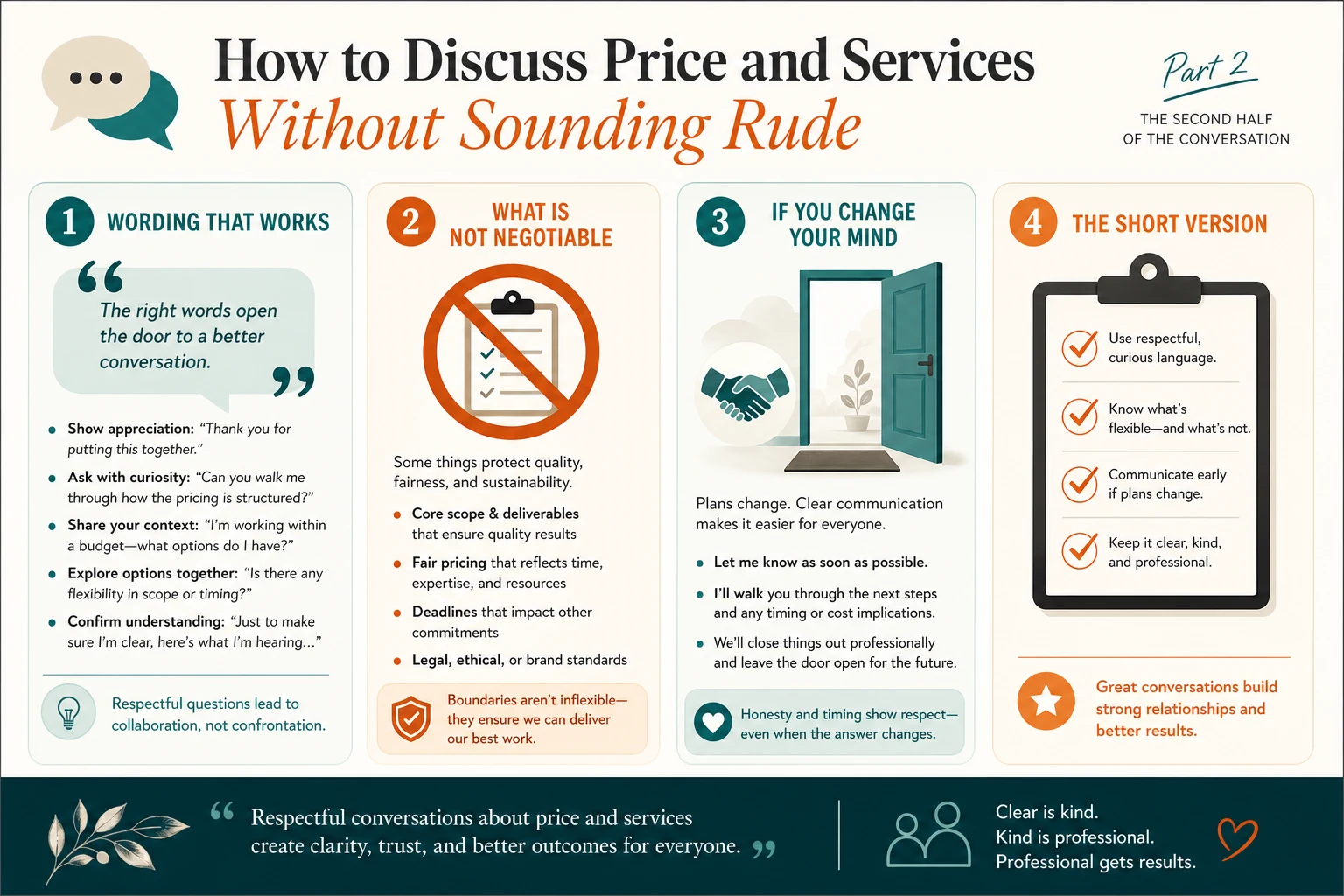
Tone does more work than vocabulary here. These versions sound normal in a Vienna club, in English or in German:
- “Can you tell me how your prices work?”
- “What is the usual time, and what would the price be for that?”
- “Is that with everything, or are there extras?”
What lands badly is the discount opening: “How much for everything?”, “Can you do it cheaper?”, or a comparison with another venue or another person. It usually ends the conversation rather than starting it.
What is not negotiable
Some parts of the visit are set by the house, not by the person you are talking to. The entry fee, the drink prices and the room charge belong to the venue, and no one at the table can change them. Venues that publish this openly make the evening easier to plan, which is one reason it is worth checking a published price list before you go.
This is also where the difference between venues shows. The way pricing is structured in a club is not the same as with an agency booking, a contrast we covered in escort services compared with brothels.
The other non-negotiable is the service list. A “no” is not an opening bid, and pushing it is the single fastest way to end a visit badly. Condom use falls in the same category.
Currency and payment method are worth clarifying early too, because not every venue and not every person handles cards the same way. It is worth knowing in advance what to bring with you, cash included.
If you change your mind
You are allowed to end the conversation. If the price is higher than you expected, or the chemistry is not there, a simple “thank you, I will think about it” is complete and normal. No explanation is needed, and it is better than agreeing out of politeness and regretting it in the room.
The same is true in reverse: she may decline you, and that is equally allowed. It is a professional decision, not a verdict on you.
If you already paid for time and then decide against continuing, the time is usually still charged, exactly as with any booked service. Deciding at the bar costs nothing; deciding behind the door costs the booking.
The short version
- Ask at the bar, not in the room.
- Three questions: time and price, what is included, what is not offered.
- Plain wording beats clever wording, and discount hunting kills the mood.
- House fees are fixed; the service list is hers and is not a starting position.
- Walking away before the room is free and completely normal.
Talking about money is a thirty-second conversation that prevents most of the bad stories people tell about their first visit. Whether you are comparing venues or planning your first night out, the same rule applies here as everywhere else in the scene: clarity about spending is what makes the evening relaxed.