

Somewhere between a profile photo and a price, most listings in Vienna include a set of abbreviations. Guests read them as a menu, arrive expecting the menu to be binding, and are surprised when it is not.
A service list is useful, and it is worth knowing exactly what kind of document it is: an opening position written by one person about herself, not a catalogue issued by the venue.

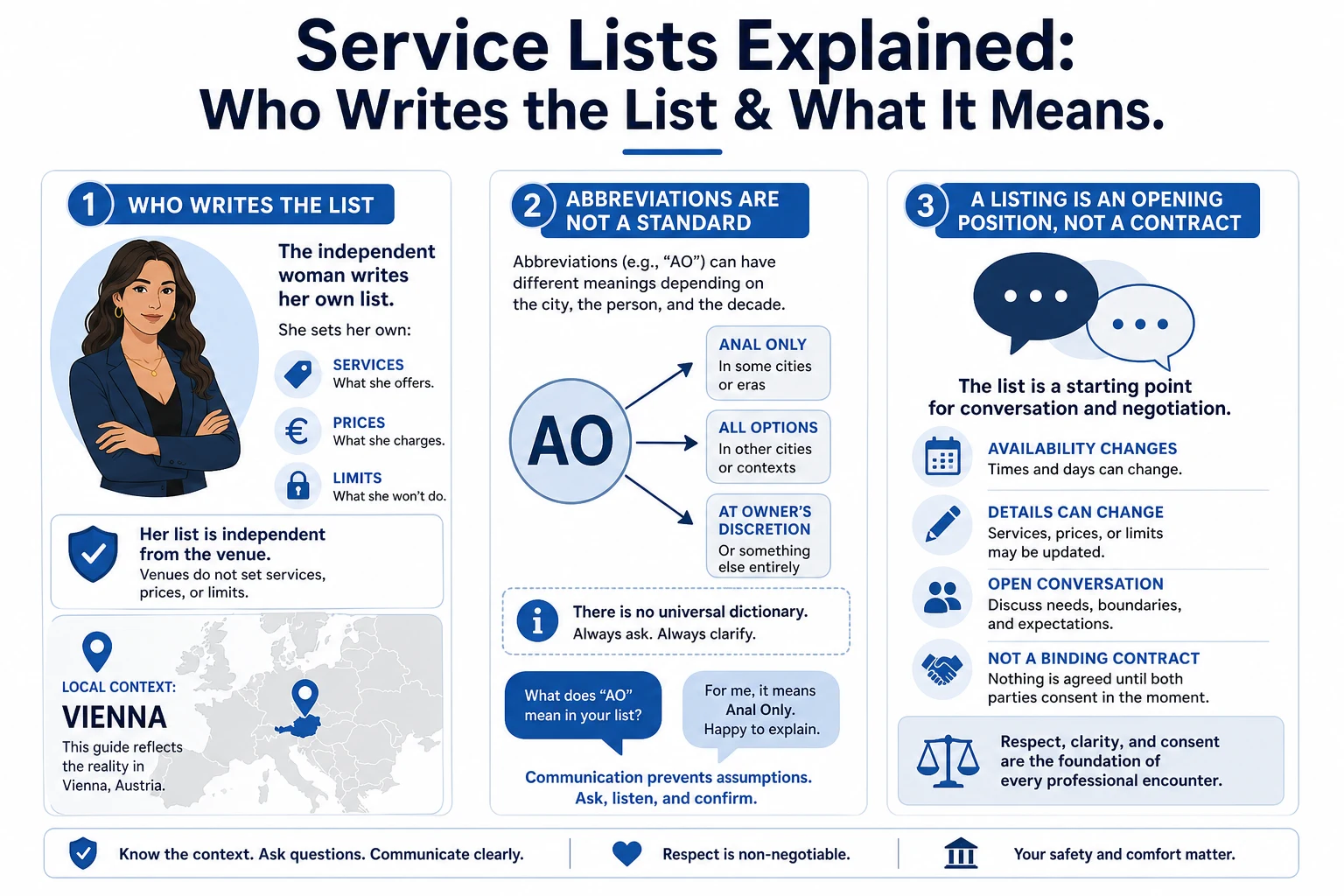
Who Writes the List
She does. This is the whole explanation, and almost everything else follows from it.
In a licensed Vienna venue the women are independent. They are not employees with a job description handed to them at reception. Each one decides what she offers, what she does not, what she charges and who she works with, and the club has no authority to sell anything on her behalf.
That is why two women working the same corridor on the same evening can have completely different lists at completely different prices, and why neither of them is doing anything unusual. It is the same structural fact that explains the difference between escort services and brothels: in both, the agreement is with the person, not with the business.
The Abbreviations Are Not a Standard
The shorthand you see in listings grew out of forums, not out of any industry body, and it drifted differently in different countries and different decades.
Two consequences matter. First, the same letters can mean slightly different things to the person who wrote them and the person reading them. Second, a term that is common in one city’s listings may be unknown in another’s. The explainer on what AO means in Vienna is a good example of a term that carries more weight than its two letters suggest.
The practical rule: if a term matters to your evening, say it in words rather than in letters. Confirming in plain language takes five seconds and removes the entire category of misunderstanding.
A Listing Is an Opening Position, Not a Contract
Even a list written by the person herself describes what she generally offers, not what she has committed to tonight.
Availability changes with the day, the health of the person, how the shift has gone and simply whether she wants to. A service on the list can be declined without explanation, and that is not a bait and switch, it is the same right to refuse that applies to everyone else in the building.
The reverse also happens: something not listed may be perfectly fine, and the only way to find out is to ask. The list is a starting point for a conversation, and the conversation is where the actual agreement gets made.
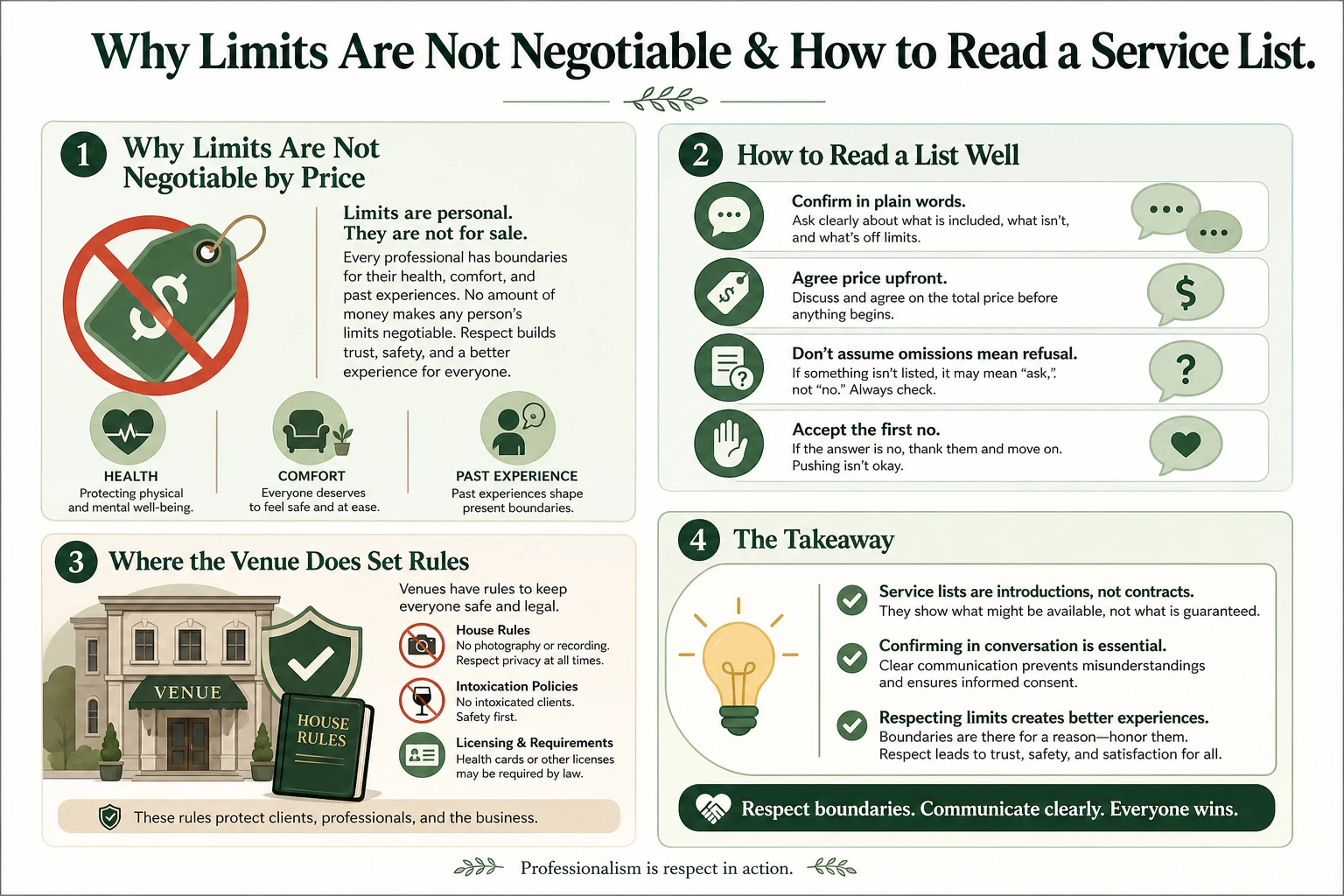
Why Limits Are Not Negotiable by Price
Raising the offer is the most common mistake guests make, and it is read exactly as it sounds.
A limit usually exists for a reason that money does not touch: health, comfort, a past experience, or simply preference. Pushing against it with a higher number does not present a better deal, it presents a guest who did not accept the first answer, and that is the point at which a reasonable evening turns into a short one. Our guide to the unwritten rules every visitor should follow puts this near the top for good reason.
Health-related limits deserve particular respect, since they protect both people. This overview of condom rules in professional escorting explains why the boundary usually is not personal.
How to Read a List Well
- Treat it as information about a person, not as a price list from a business.
- Confirm anything that matters in plain words, before anything starts.
- Agree the price in the same conversation, not afterwards.
- Do not read omissions as refusals, and do not read inclusions as guarantees.
- Accept the first no, every time.
Where the Venue Does Set Rules
The club is not absent from this. It sets the house rules that everyone in the building follows, and those are not individually negotiable: no photography, no pressure, no intoxicated guests, and removal for anyone who ignores them. Why sex clubs keep strict house rules explains what that framework protects.
It also operates inside a licensing system, and the women working there are registered and carry a health and control card, as our explainer on the Green Book describes. So there are two layers: the venue’s rules, which apply to everyone, and each person’s own limits, which apply to her. Neither overrides the other.
The Takeaway
A service list tells you what one independent person generally offers, written in shorthand that no authority standardised, on a night that has not happened yet. Read it as an introduction rather than a contract, confirm what matters in plain words, agree the price in the same breath, and take the first answer as the final one. Do that and the list does its job, which is to save you both a conversation you did not need to have.